Wednesday, January 12, 2011
Documentum Foundation Classes 6
Sunday, December 19, 2010
Microsoft Dynamic Langugage Runtime (DLR)
The DLR provides three key components:
- language implementation services with language interoperability model
- dynamic language runtime services with fast dynamic dispatch and library support
- common hosting APIs across languages
- port dynamic languages to .NET
- add dynamic features to your existing language
- author libraries whose objects support dynamic operations
- employ dynamic languages in your applications and frameworks.
The DLR Hosting API is a programming interface that allows one language’s code to execute in another
language. It helps in using a Dynamic Language’s Code in a Static Language.
Dynamic Languages - Outside .net family of languages. For example: Ruby or Python
Static Languages - .NET languages like VB.net, C#.net etc.
For more information please visit http://dlr.codeplex.com/
Monday, November 08, 2010
K2 BlackPoint
It has two designers a). K2 Studio and b). K2 Web Designer
Benefits:
a). Visual tools to create worflow.
b). No coding required.
c). Tools that can be used by non developer.
For more information visit http://www.k2.com/en/blackpoint.aspx
Wednesday, October 13, 2010
Generate barcodes using barcode4j
a) Implementations
* 1D barcode implementations
o Interleaved 2 of 5
o Code 39
o Code 128
o Codabar
o POSTNET & more
* 2D barcode implementations :
o PDF 417 (ISO/IEC 15438:2001(E))
o DataMatrix (ISO/IEC 16022:2000(E))
http://barcode4j.sourceforge.net/2.0/output-formats.html
d) Command-line interface
barcode4j has command line support so you can generate barcode by executing a command on command line.
e) Plug-ins/extensions for third-party products:
o Apache Xalan: SVG-generating XSLT extension
o SAXON XSLT Processor : SVG-generating XSLT extension
o Apache FOP: support as fo:instream-foreign-object
For more information go to http://barcode4j.sourceforge.net/
Wednesday, October 06, 2010
IBM Classification Module and Content Extractor
IBM WebSphere Transformation Extender (WTX)
Thursday, September 30, 2010
Making CXF Web service accept SOAP 1.2 request
Calling SSL enabled CXF Web Service From Java Client
Monday, August 02, 2010
What is JaWin and how to use it?
The Java/Win32 integration project (Jawin) is a free, open source architecture for interoperation between Java and components exposed through Microsoft's Component Object Model (COM) or through Win32 Dynamic Link Libraries (DLLs).
For more information visit http://jawinproject.sourceforge.net/
How to use Jawin - A practical example
================================
a). If you have .tlb (COM Type Library) file available for the COM object you want to use then skip Step1 and proceed to Step3.
b). If you already have .Net component ready which you want to use from Java code then proceed to Step2:
c). If you want to develop a .NET component to be used via JAWIN then proceed to Step1:
Step1: Developing a .Net component (class library)
(a). Create an interface and before its declaration put .net attribute as given below
[Guid("3823a63d-5891-3b4f-A460-DB0FB847075A")]
See the code snippet below for mor einformation:
using System;
using System.Collections.Generic;
using System.Text;
using System.Runtime.InteropServices;
namespace Org.Jawin.ManageWinProcess
{
[Guid("3823a63d-5891-3b4f-A460-DB0FB847075A")]
public interface IWinProcessOperations
{
Boolean IsProcessActive(String sProcessName);
Boolean KillRunningProcess(String sProcessName);
}
b) Now Implement the interface created above and in the implementation class before the name of class declaration, type the following attributes
[Guid("25c2f5a2-1afe-36ce-BE27-84E040F5E19A")]
[ProgId("Jawin.WinProcessOps")] // You would be using this prog id while creating an instance of this class in JAVA.
See the code snippet below for more information:
using System;
using System.Collections.Generic;
using System.Text;
using System.ServiceProcess;
using System.Text.RegularExpressions;
using System.Runtime.InteropServices;
namespace Org.Jawin.ManageWinProcess
{
[Guid("25c2f5a2-1afe-36ce-BE27-84E040F5E19A")]
[ProgId("Jawin.WinProcessOps")]
public class Operations:IWinProcessOperations
{
public Operations(){ }
public Boolean isProcessActive(String ProcessName)
{
String machine = ".";
Boolean processRunning = false;
// Get the current processes
System.Diagnostics.Process[] runningProcesses = System.Diagnostics.Process.GetProcesses(machine);
// Find those that match the specified regular expression
Regex processFilter = new Regex(ProcessName, RegexOptions.IgnoreCase);
foreach (System.Diagnostics.Process current in runningProcesses)
{
// Check for a match.
if (processFilter.IsMatch(current.ProcessName))
{
processRunning = true;
break;
}
}
return processRunning;
}
public Boolean KillRunningProcess(String ProcessName)
{
String machine = ".";
Boolean processKilled = false;
// Get the current processes
System.Diagnostics.Process[] runningProcesses = System.Diagnostics.Process.GetProcesses(machine);
// Find those that match the specified regular expression
Regex processFilter = new Regex(ProcessName, RegexOptions.IgnoreCase);
foreach (System.Diagnostics.Process current in runningProcesses)
{
// Check for a match.
if (processFilter.IsMatch(current.ProcessName))
{
current.Kill();
processKilled = true;
break;
}
}
return processKilled;
}
public bool KillAndStartProcess(String ProcessName)
{
String machine = ".";
Boolean processKilled = false;
// Get the current processes
System.Diagnostics.Process[] runningProcesses = System.Diagnostics.Process.GetProcesses(machine);
// Find those that match the specified regular expression
Regex processFilter = new Regex(ProcessName, RegexOptions.IgnoreCase);
foreach (System.Diagnostics.Process current in runningProcesses)
{
// Check for a match.
if (processFilter.IsMatch(current.ProcessName))
{
current.Kill();
break;
}
}
System.Diagnostics.Process.Start(ProcessName);
return true;
}}}
Building .NET Library
In order to build the .Net Library code you have just written from the Visual Studio IDE, configure the settings as shown below:
Important: If this setting is not configured, build would generate a DLL but the TLB file generated using regasm on .net command prompt would create .tlb file which would not expose any method in JaWin browser. So this setting is crucial.
Step 2: Creating .tlb file for the .net component
You can create a tlb file for the .net component using Assembly Registration Tool in the Visual Studio command prompt.
Syntax : Regasm /tlb “dll path with dll name”
e.g : regasm /tlb “c:\winprocess.dll” (suppose name of our dll is winprocess.dll and it is available at c:\)
The above command would generate the corresponding .tlb file.
Step 3: How to use JAWIN BROWSER and create JAWIN stub for Java for COM
Download JaWin and extract its files in a directory. Suppose JaWin is available in c:\JaWin folder. Open command prompt and reach the ‘typeBrowser’ folder in Jawin directory.
C:\Jawin\jawin-2.0-alpha1\typebrowser
And then type
java -Xmx256M -jar jawinBrowser.jar
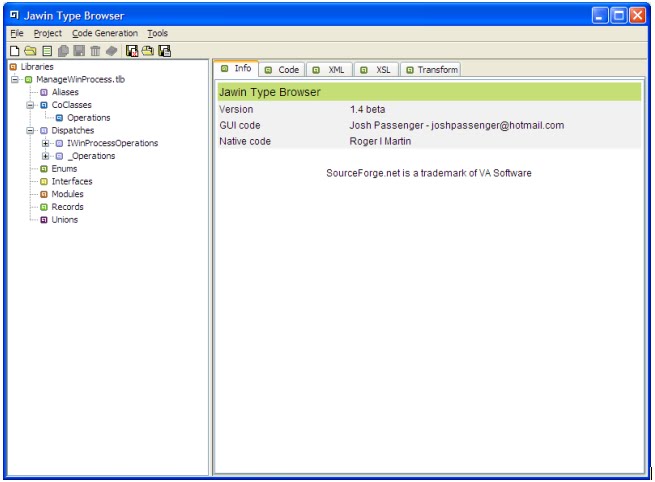
and hit Enter. [Note: Xmx256M in the above command allocates 256 MB RAM to this process]. It would then start the Applet as shown below:
Go to option ‘Project’ -> ‘New Project’ and type project name and then click on ‘New’ button as shown below:
Reach to your TLB file and when you are done, the contents of your tlb would be displayed as shown below:
Expand your interface (IwinProcessOperations in this case) and then select ‘Code Generation’->’Generate Selected Code’ and it would show the corresponding JAVA code under ‘Code’ tab as shown below:
Save this code as a JAVA class. Now you can import this class and use its methods in your code.
Note: Don’t try to modify this class file.
HOW to use JAWIN stub in java application
a). Include jaWin.jar in your build path and
b). Point to the path of jaWin.dll in run configuration by adding the following string under VM arguments(if running the code in eclipse or RAD)
-Djava.library.path="c:\JawinPath"
c). If you have .NET dll, put it in your project folder and register it using regasm command. If you are using pure COM dll then use regsvr32 command to register the COM component.
d). If you are using .net dll which was exposed as a COM then you would need to copy the .net dll in JDK\bin directory otherwise your program would not be able to find the object. This step is nor required if you are using pure COM. For more information visit http://jawinproject.sourceforge.net/jawinarchitecture.html
c). Import/add the Java class (JaWin stub) file created above in your application and then use it. The below snippets shows how to use this stub.
public static void main(String[] args)
{
boolean bResult;
IWinProcessOperations ops=null; //Jawin stub for the COM component
try
{
//I have used Jawin.WinProcessOps because this was mentioned as a Prog id in the //class in .net.
// You should use the prog id of your COM accordingly.
ops = new IWinProcessOperations("Jawin.WinProcessOps");
}
catch (COMException e1)
{
e1.printStackTrace();
}
try
{
bResult=ops.KillRunningProcess("WINWORD");
System.out.println("Process is active " + bResult);
}
catch (COMException e)
{
e.printStackTrace();
}
}
Monday, July 26, 2010
Various measurement factors to be considered for developing Enterprise Applications
Response time is the amount of time it takes for the system to process a request from the outside. This may be a UI action, such as pressing a button, or a server API call.
Responsiveness
Responsiveness is about how quickly the system acknowledges a request as opposed to processing it. This is important in many systems because users may become frustrated if a system has low responsiveness, even if its response time is good. If your system waits during the whole request, then your responsiveness and response time are the same. However, if you indicate that you've received the request before you complete, then your responsiveness is better. Providing a progress bar during a file copy improves the responsiveness of your user interface, even though it doesn't improve response time
Latency
Latency is the minimum time required to get any form of response, even if the work to be done is nonexistent. It's usually the big issue in remote systems. If I ask a program to do nothing, but to tell me when it's done doing nothing, then I should get an almost instantaneous response if the program runs on my laptop. However, if the program runs on a remote computer, I may get a few seconds just because of the time taken for the request and response to make their way across the wire. As an application developer, I can usually do nothing to improve latency. Latency is also the reason why you should minimize remote calls.
Throughput
Throughput is how much stuff you can do in a given amount of time. If you're timing the copying of a file, throughput might be measured in bytes per second. For enterprise applications a typical measure is transactions per second (tps), but the problem is that this depends on the complexity of your transaction. For your particular system you should pick a common set of transactions.
Performance
Performance is either throughput or response time—whichever matters more to you. It can sometimes be difficult to talk about performance when a technique improves throughput but decreases response time, so it's best to use the more precise term. From a user's perspective responsiveness may be more important than response time, so improving responsiveness at a cost of response time or throughput will increase performance.
Load
Load is a statement of how much stress a system is under, which might be measured in how many users are currently connected to it. The load is usually a context for some other measurement, such as a response time. Thus, you may say that the response time for some request is 0.5 seconds with 10 users and 2 seconds with 20 users.
Load sensitivity
Load sensitivity is an expression of how the response time varies with the load. Let's say that system A has a response time of 0.5 seconds for 10 through 20 users and system B has a response time of 0.2 seconds for 10 users that rises to 2 seconds for 20 users. In this case system A has lower load sensitivity than system B. We might also use the term degradation to say that system B degrades more than system A.
Efficiency is performance divided by resources. A system that gets 30 tps on two CPUs is more efficient than a system that gets 40 tps on four identical CPUs.
Capacity
The capacity of a system is an indication of maximum effective throughput or load. This might be an absolute maximum or a point at which the performance dips below an acceptable threshold.
Scalability
Scalability is a measure of how adding resources (usually hardware) affects performance. A scalable system is one that allows you to add hardware and get a commensurate performance improvement; such as doubling how many servers you have to double your throughput. Vertical scalability, or scaling up, means adding more power to a single server, such as more memory. Horizontal scalability, or scaling out, means adding more servers.
Wednesday, May 26, 2010
Enterprise Content Management Solution (ECM) Providers
Here is a list :
IBM
IBM Content Management
Vignette (Open Text)
http://www.vignette.com/us/Solutions/Web-Content-Management
Documentum
http://www.emc.com/domains/documentum/index.htm
HummingBird
Newgen
http://www.newgensoft.com/in/en/enterprise_content_management
LiveLink
http://www.opentext.com/2/sol-products/sol-pro-llecm10.htm
Microsoft Share Point
http://sharepoint.microsoft.com/en-us/Pages/default.aspx
Alfresco Content Management
http://www.alfresco.com/
There are many more which can be added into list but these are the ones which I have heard about the most.
Monday, April 19, 2010
WPF 4 - New/Enhanced features
http://10rem.net/blog/2010/04/12/wpf-4-release-a-guide-to-the-new-features
ClearType
http://research.microsoft.com/en-us/projects/cleartype/
Custom Dictionaries APIs
WPF Text Team Blog post on Custom Dictionaries in WPF 4
Pixel Shader 3 Support
Create Custom Pixel Shader Effects for
WPF http://windowsclient.net/learn/video.aspx?v=296117
Removal of legacy Bitmap Effects
The old legacy bitmap effects (bevel, drop shadow, blur etc.) are still present, but there's zero implementation. The effects that have shader versions (blur, drop shadow) get forwarded to the shader implementation. The other effects (bevel, for example) simply do nothing. Your code will compile, but the effects themselves are no-ops. In .NET 3.5sp1, they were marked as deprecated, so this is not surprising.
Bitmap effects are software-only, and couldn't be hardware accelerated. One of the biggest performance issues with old WPF applications was use/overuse of bitmap effects. Pixel shader-based effects are much more performant. I'm glad to see we aren't afraid to cull when we come up with something better.
The replacement effects are just as easy to use as the old effects, and will even render on the design surface.
http://10rem.net/blog/2010/04/12/wpf-4-release-a-guide-to-the-new-features
Tuesday, April 06, 2010
FileNet Image Manager Active Edition
FileNet BPM), eForms management (IBM FileNet Forms Manager), email management (IBM FileNet Email Manager) and more.
Image Manager Active Edition allows you to link content with business processes, activating that content so that it drives workflows within your organization. This level of integration activates your business, enabling you to work with content that makes a positive impact within seconds of a document image reaching your
system, rather than the weeks it can take with paper or other software solutions.
For more info visit http://www-01.ibm.com/software/data/content-management/filenet-image-manager/
Microsoft Windows Presentation Framework (WPF)
Nice book on Microsoft WPF
Windows Presentation Foundation Unleashed (WPF)
Wednesday, February 10, 2010
Microsoft Share Point
Share point is one of the Microsoft Web Server products. It is a web-based collaboration, document management, and process management product that allow us to build an enterprise portal. It aims at following:
a). To improve team productivity by allowing staff to collaborate efficiently.
b). To provide the staff with the information they need.
c). To provides us with the framework to create websites that not only provide access to documents and shared workspaces but also allow other web-based applications such as wikis and blogs to be created.
d). It also allows elaborate workflows to be created, allowing business processes to be monitored and actioned.
Share point refers to two products:
a). Windows SharePoint Services (WSS)
It is a free add-on for Windows server which provide following features:
- Wiki
- Workflows
- Blog
- Document management with version control
- Team sites
- RSS support etc.
b). Microsoft SharePoint Server
It is a product purchased separately from WSS and adds following features to the basic features discussed above:
- Improved Document Management
- Project Management
- Enterprise Search
Share point is suited for medium-sized companies or large enterprises.
Lock, Save and Unlock Methods in Capture professional
Dim oBatch as RepObject
If oBatch.Lock then
oBatch.Name = “newname”
oBatch.Save
oBatch.Unlock
EndIf
The Lock, Save and Unlock methods each return a boolean value indicating success or failure. Locking a RepObject locks all the children of that RepObject. Saving a RepObject saves all of the children of that RepObject. Each call to the Lock method must eventually be matched with a call to the Unlock method by the same user before a RepObject is fully unlocked. The RepObject manages an internal lock count that is incremented by the Lock method and decremented by the Unlock method. The RepObject is deemed no longer locked when this lock count reaches zero. For example, if an application calls the Lock method twice on a given RepObject, it must eventually call Unlock twice on the same RepObject
Thursday, January 21, 2010
DLL names for various Capture repositories
Local Repository ....................... RILLocal.dll
Shared repository ....................... RILShared.dll
CE Repository ....................... RILCE.dll
Shared CE Repository ....................... RILSharedCE.dll
Image Services Repository ....................... RILBES34.dll
Offline IS Repository ....................... RILOfflineIS.dll
Shared CS Repository ...................... RILSharedCE.dll
Shared Offline IS Respository ...................... RILSharedOLIS.dll
Monday, January 04, 2010
Using IBM MQ from a windows form based .NET application
1). IBM WebSphere MQ client + Fix Pack 6.0.2
2). IBM Message Service Client for .NET (Available for download from http://www-01.ibm.com/support/docview.wss?rs=171&uid=swg24011756)
Saturday, December 12, 2009
Internet Connection is being shown but not openeing any site - Ubuntu 9.X
Find the entry network.dns.disableIPv6.
Double click this entry would change its value to 'true'
Rebooot pc and internet would work.
Please visit the below link for more information
https://help.ubuntu.com/community/WifiDocs/WirelessTroubleShootingGuide